Beat the Heat: Solar Shading & Ventilative Cooling
639005475329044805.png?width=&height=&mode=crop "Beat the Heat: Solar Shading & Ventilative Cooling")
Overheating is becoming a growing challenge in today’s well-insulated buildings. While insulation keeps energy performance high, it also traps unwanted heat — especially during warm summers. The real drivers behind rising indoor temperatures are solar gains during the day and insufficient cooling at night. In this blog, we explore how solar shading and ventilative (night) cooling work together to keep indoor spaces comfortable.
Subsequently more buildings – both new and renovated – struggle with overheating. The real drivers are solar gains during the day and insufficient night cooling, which together push indoor temperatures to uncomfortable levels.
In this blog, you will discover how solar shading and natural night cooling work together to keep heat out, and how DUCO solutions such ventilative cooling and solar shading significantly enhance summer comfort.
Why buildings overheat
Modern, well-insulated buildings trap heat effectively. But that also means they retain unwanted heat in summer. The key factors that determine indoor temperature are:
- Solar radiation through glazed surfaces
- Thermal insulation that prevents heat from escaping
- Ventilation possibilities, especially at night
- Internal heat sources such as appliances and occupants
Solar radiation is by far the biggest source of heat ingress. Preventing heat from entering is therefore the first and most impactful step towards a cooler and more comfortable indoor climate.
Building Regulations Part O: Overheating in the UK
In the United Kingdom, Part O of the Building Regulations was introduced in June 2022 to address the growing issue of overheating in new residential buildings, particularly in the context of climate change and increasingly well-insulated homes. It aims to ensure buildings are designed to limit solar gain in the summer and provide adequate means of removing excess heat to protect the health and welfare of occupants.
Part O applies exclusively to new residential buildings, including dwellings, institutions, and student accommodation. It splits England into areas of 'moderate risk' and 'high risk' of overheating, with the latter including urban and some suburban parts of London. Compliance can be demonstrated through two methods: the Simplified Method, which limits glazing area and requires adequate ventilation, or Dynamic Thermal Modelling using CIBSE's TM59 methodology, a standardized approach to predicting overheating risk in residential building designs
Under Part O, overheating is approached on a basis of prevention and remedy: prevention by limiting the amount of direct sunlight through windows and glazing, and remedy by providing adequate ventilation to remove excess heat. External shading and cross-ventilation are key strategies for meeting Part O requirements, ensuring new homes remain comfortable during increasingly hot summers without over-reliance on mechanical cooling.
The impact of solar radiation
Windows: the main source of heat gain
Glazing is responsible for the largest share of unwanted heat entering a building. Depending on the glass type, orientation and shading, this can amount to:
- Up to 700 W/m² solar gain on a sunny day
How solar shading makes the difference
External solar shading is the most effective way to block solar radiation before it reaches the glass and heats your home. The effect is significant: in a new-build property with good insulation (Rc = 4.7 Km²/W) and high-quality glazing (U-value = 1.0 W/m²K), the cooling load drops by as much as 1 kW when you use screens.
Cooling load without solar shading: 2.8 kW
- 200 W through transmission (heat conduction through walls, windows and roofs)
- 2000 W through solar gain on windows
- 100 W through ventilation air (warm air from outside to inside)
- 500 W through occupants and electrical appliances
Cooling load with solar shading: 1.8 kW
- Screens reduce the cooling load by 1100 W
- This means 40% less energy needed to keep your home cool
- At an outside temperature of 31°C and desired inside temperature of 24°C
DUCO solutions:
Both prevent overheating by stopping solar gains at the façade.
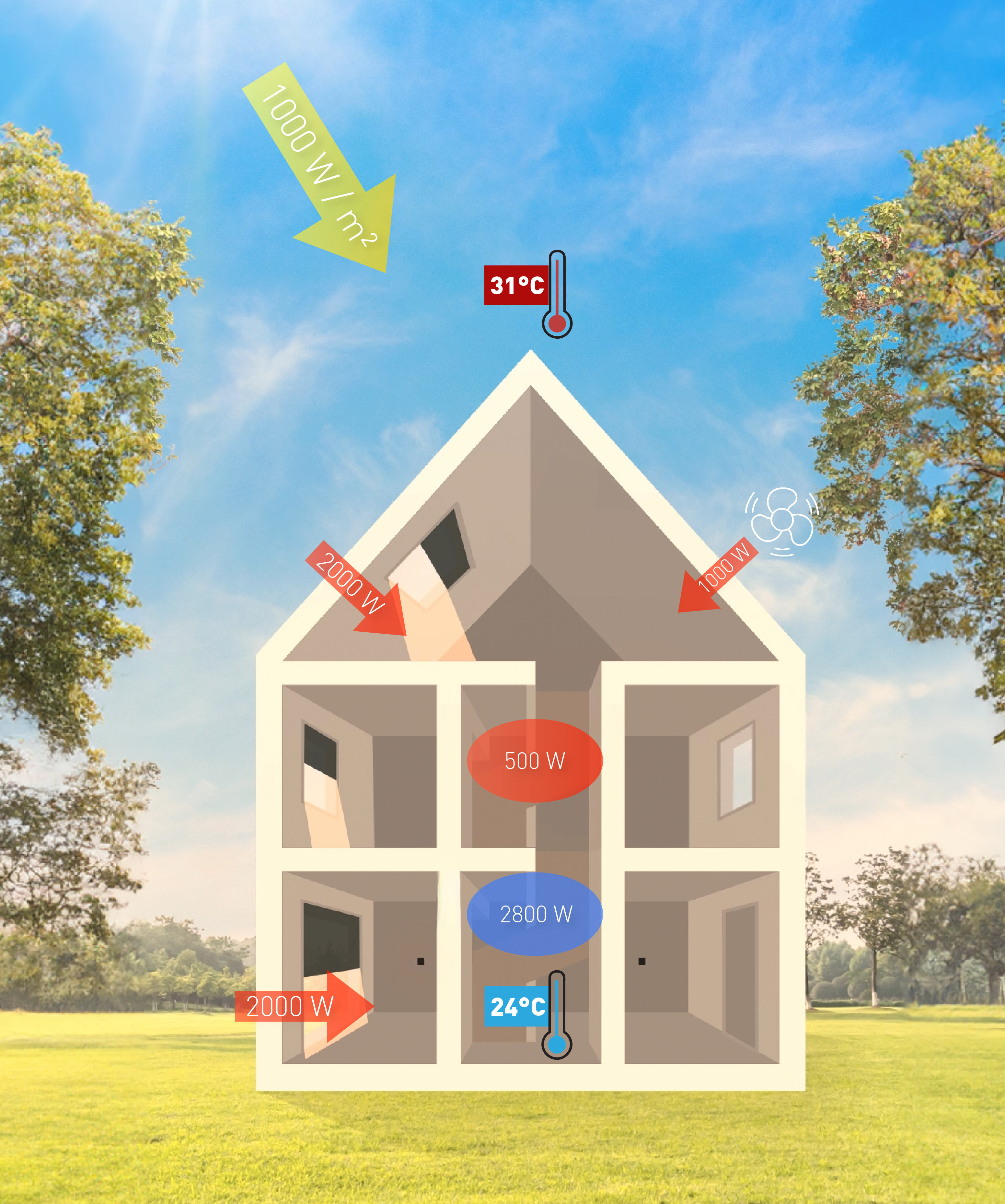
Situation without solar shading
Using the house without solar shading
- This concerns a newly built property with insulation Rc = 4.7 m²K/W and U-value windows = 1.0 W/m²K
- Solar irradiation for our latitude = 1,000 W/m²
- Outside temperature is assumed to be 31°C / inside set point is 24°C
- The cooling load for this property = 2.8 kW
To maintain the property at 24°C, 2.8 kW of heat must be removed – the so-called cooling load. Heat enters the property through:
- 200 W through transmission (heat conduction through walls, windows and roofs) from outside to inside
- 2,000 W through solar radiation on windows
- 100 W through ventilation air (warm air entering from outside)
- 500 W through occupants and electrical appliances
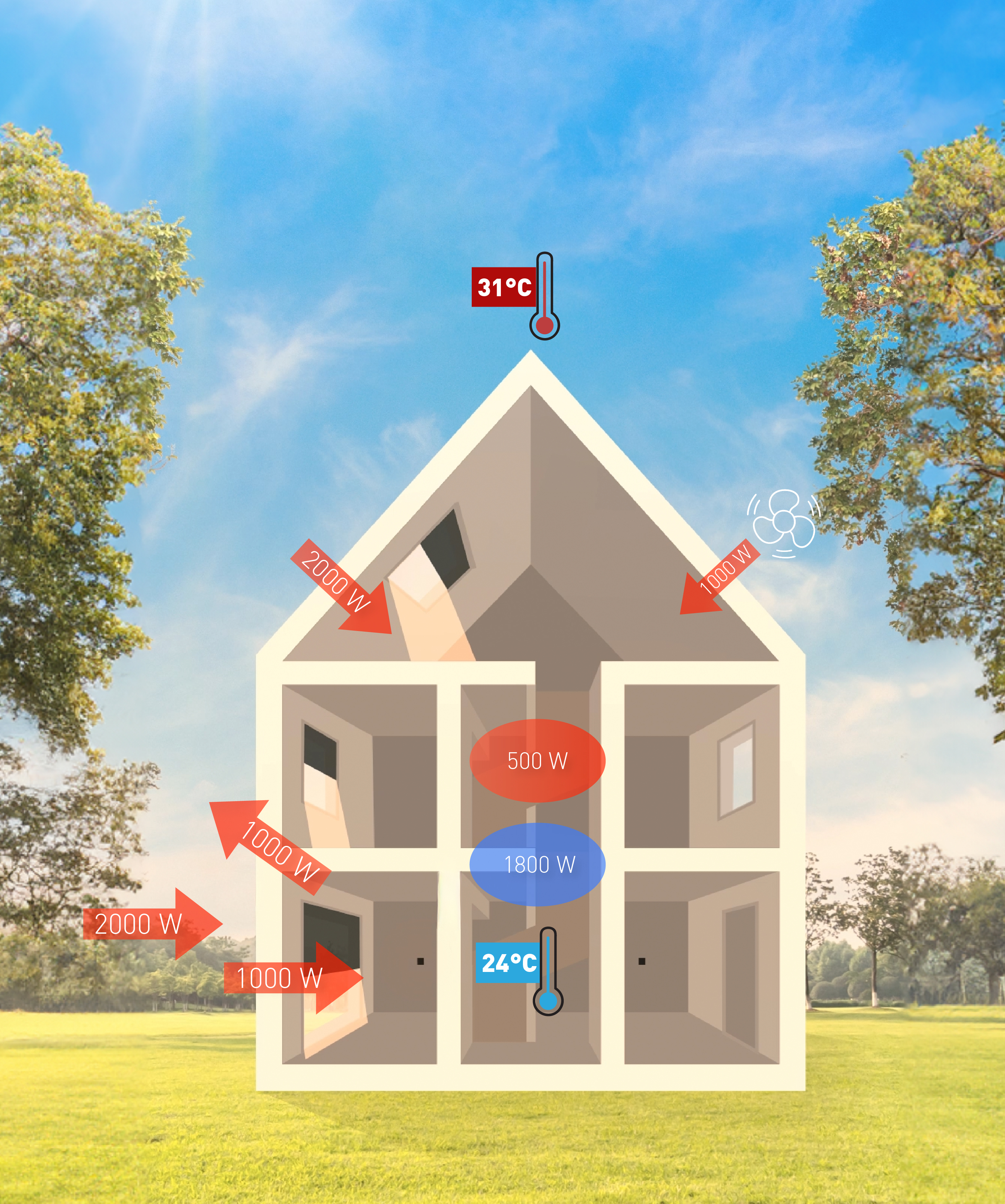
Situation with solar shading:
- This concerns a newly built property with insulation Rc = 4.7 m²K/W and U-value windows = 1.0 W/m²K
- Solar irradiation for our latitude = 1,000 W/m²
- Outside temperature is assumed to be 31°C / inside set point is 24°C
- The cooling load for this property is now 1.8 kW
To maintain the property at 24°C, 1.8 kW of heat must be removed – the so-called cooling load.
The screens ensure that 1,100 W less cooling is required.
Insulation: helpful but not always enough
Highly insulated walls and roofs reduce heat transfer from outside to inside. However, they also make it harder for accumulated indoor heat to escape. That is why active, natural heat removal at night is essential.
Heat flow through walls and roofs
In well-insulated new-build properties, heat conduction through the building envelope is limited. Thanks to modern insulation standards (Rc = 4.7 Km²/W), heat flow through transmission amounts to just 200 W – less than 10% of the total cooling load. This illustrates that in contemporary homes, it's not the walls and roofs that pose the problem, but rather the solar gain through the glass. Therefore, investing in effective solar shading is essential for a comfortable indoor climate during warm summer days.Although these numbers are small compared to windows, the trapped heat inside still needs an escape route.
Night cooling: the natural air conditioner
Night cooling or ventilative cooling cools the building by allowing cool night air to flow in and displace the warm air. The greater the temperature difference, the more effective the cooling.
Three types of natural night ventilation
| Type of ventilation | Application | Pros |
|---|---|---|
| Single-sided ventilation | Single façade rooms | Simple and cost-effective |
| Cross ventilation | Rooms with two façade openings | Strong airflow |
| Stack ventilation | Buildings with height differences | Most powerful and stable |
In our example, we use a stack system: Specify conditions as indicated in the drawing.
DUCO products enabling night cooling
- DucoGrille Close 105: blade damper for night cooling
- DucoGrille NightVent: glass-replacing ventilation hatch with manual or fully automatic operation
Night cooling can keep the indoor temperature 4–6°C lower throughout the summer.
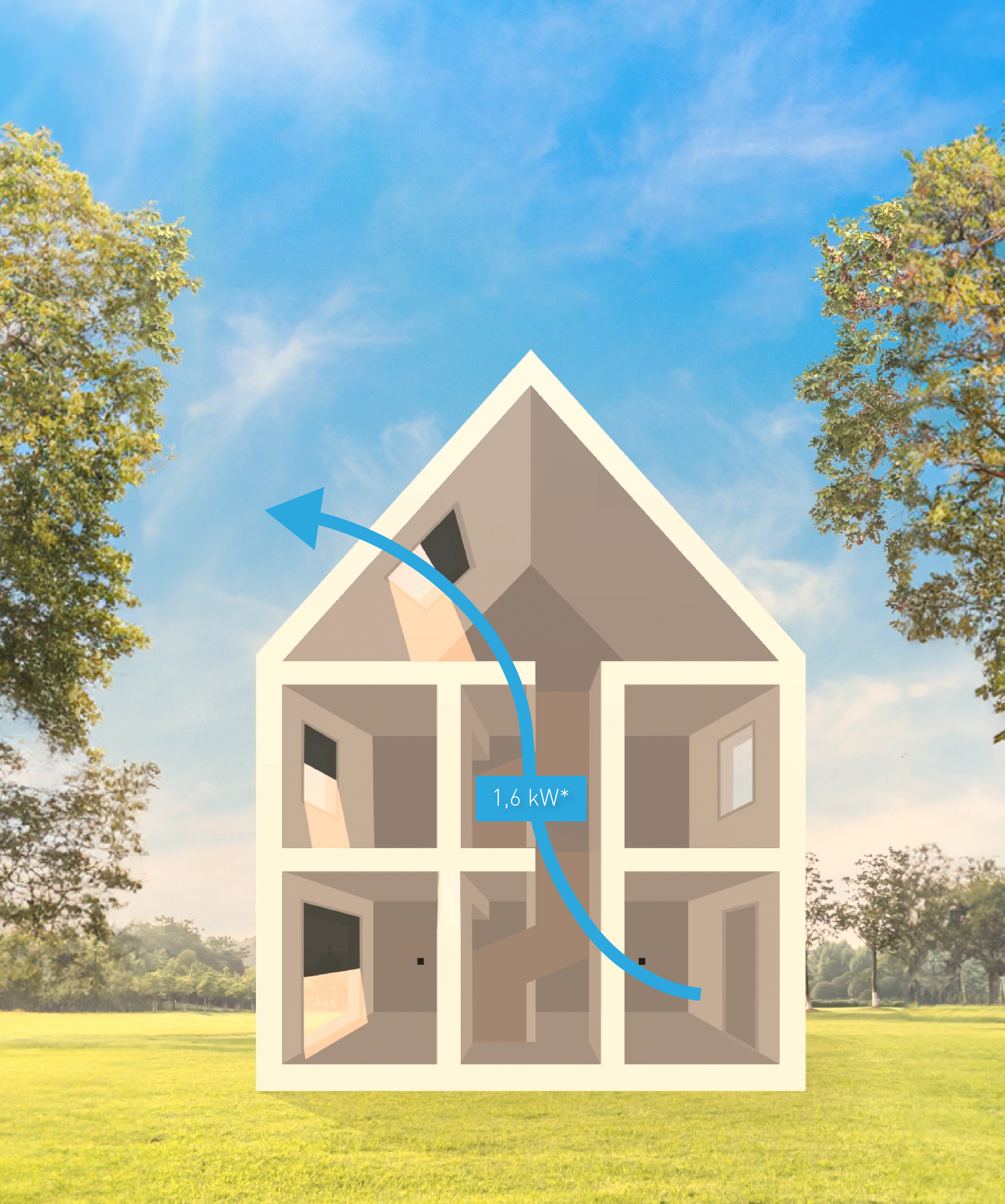
Ventilative (night)cooling
- 1.6 kW average over the course of the night
- Stack system with a Ducogrille Solid G30++ of 400mm × 2,115mm
- Height difference of 6m and temperature difference between inside and outside of 6°C
FAQ
Is external solar shading more efficient than internal blinds?
Yes. External shading blocks heat before it reaches the glass. Internal blinds only stop sunlight -not heat.
How much cooler can ventilative night cooling make my building?
Depending on the system: 3-6°C cooler, even during heatwaves.
Is ventilative cooling suitable for renovation?
Absolutely. Glass-replacing ventilation hatches and external solar shading can be integrated into existing façades.
Does ventilatieve cooling increase noise or safety risks?
DUCO solutions are designed to be secure, weather-resistant. Depending on the project, noise reduction measures may be implemented.
Conclusion
Overheating is no longer an exception - it is a predictable outcome of well-insulated buildings combined with strong solar gains. By combining effective solar shading with ventilative (night)cooling, you can eliminate up to 100 % of the heat load and maintain comfortable indoor temperatures without mechanical cooling.
Sources:
- UK Government - Building Regulations Approved Document O: Overheating
- CIBSE - TM59: Design methodology for the assessment of overheating risk